
Tools
The book’s six figures
Every figure from The Lost Art of the Plan, rebuilt as accessible web graphics with the book’s own captions and source lines, a text equivalent for each, and downloads. The same figures stand on the Tools page, where the work is.
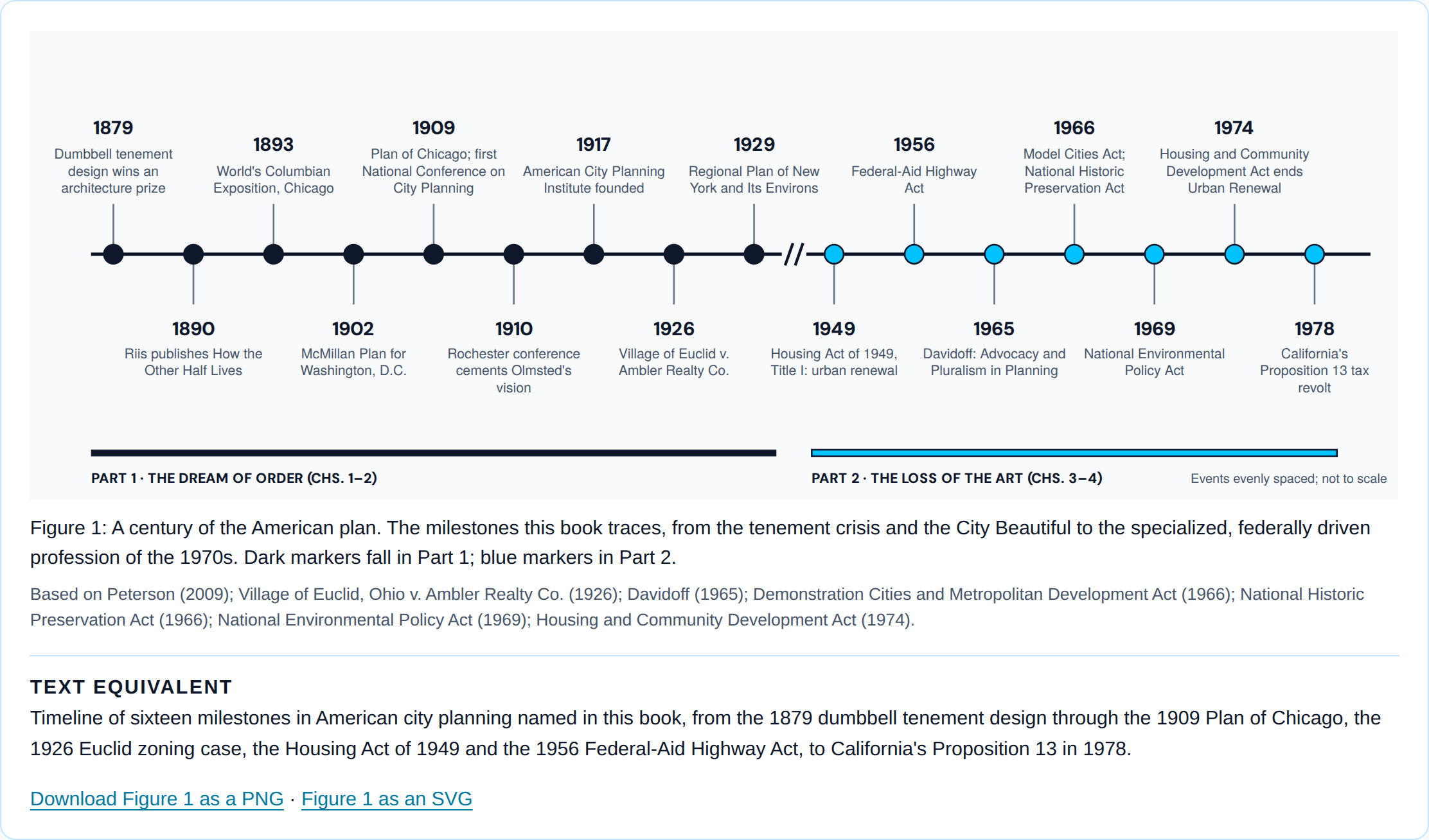
Based on Peterson (2009); Village of Euclid, Ohio v. Ambler Realty Co. (1926); Davidoff (1965); Demonstration Cities and Metropolitan Development Act (1966); National Historic Preservation Act (1966); National Environmental Policy Act (1969); Housing and Community Development Act (1974).
Text equivalent
Timeline of sixteen milestones in American city planning named in this book, from the 1879 dumbbell tenement design through the 1909 Plan of Chicago, the 1926 Euclid zoning case, the Housing Act of 1949 and the 1956 Federal-Aid Highway Act, to California's Proposition 13 in 1978.

Text equivalent
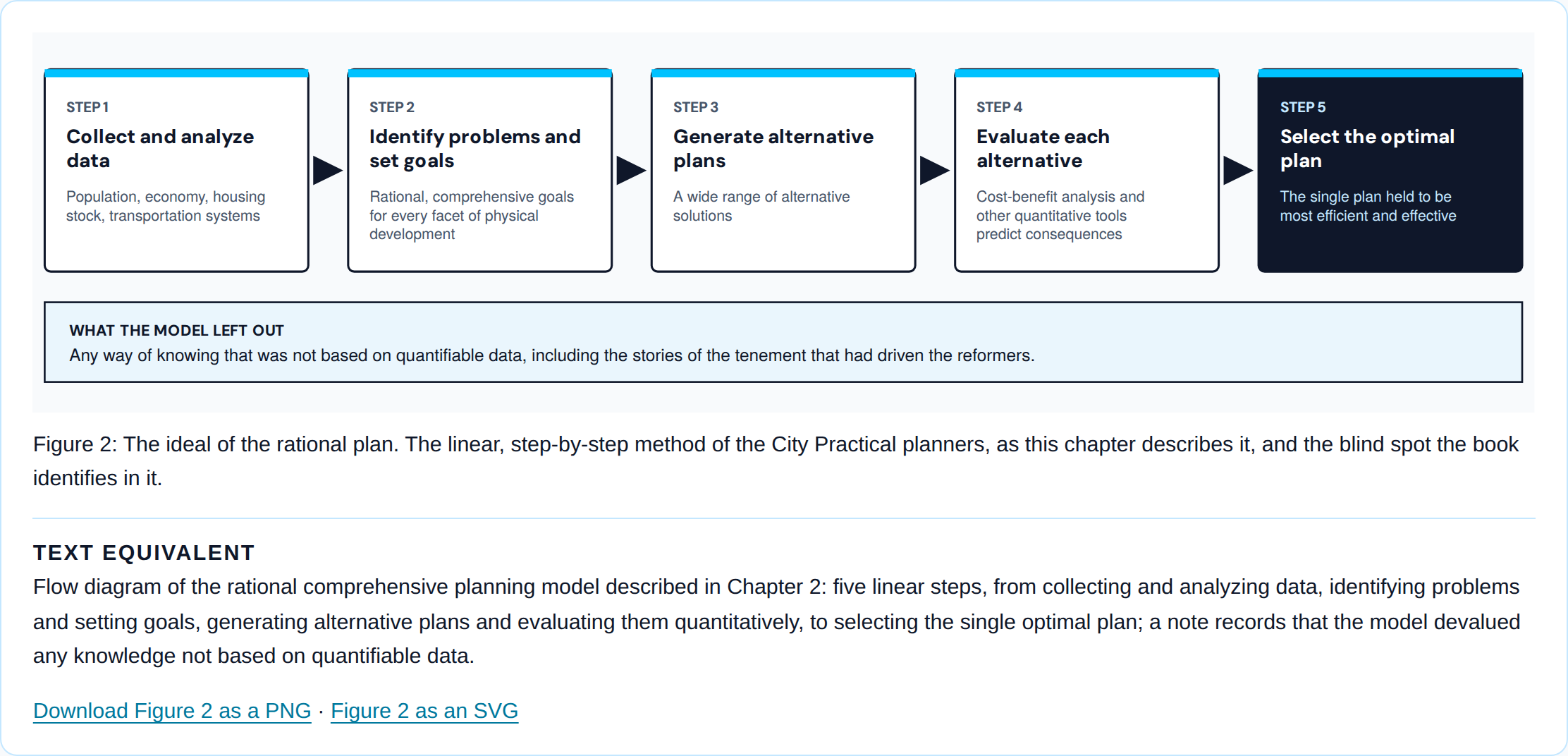
Flow diagram of the rational comprehensive planning model described in Chapter 2: five linear steps, from collecting and analyzing data, identifying problems and setting goals, generating alternative plans and evaluating them quantitatively, to selecting the single optimal plan; a note records that the model devalued any knowledge not based on quantifiable data.

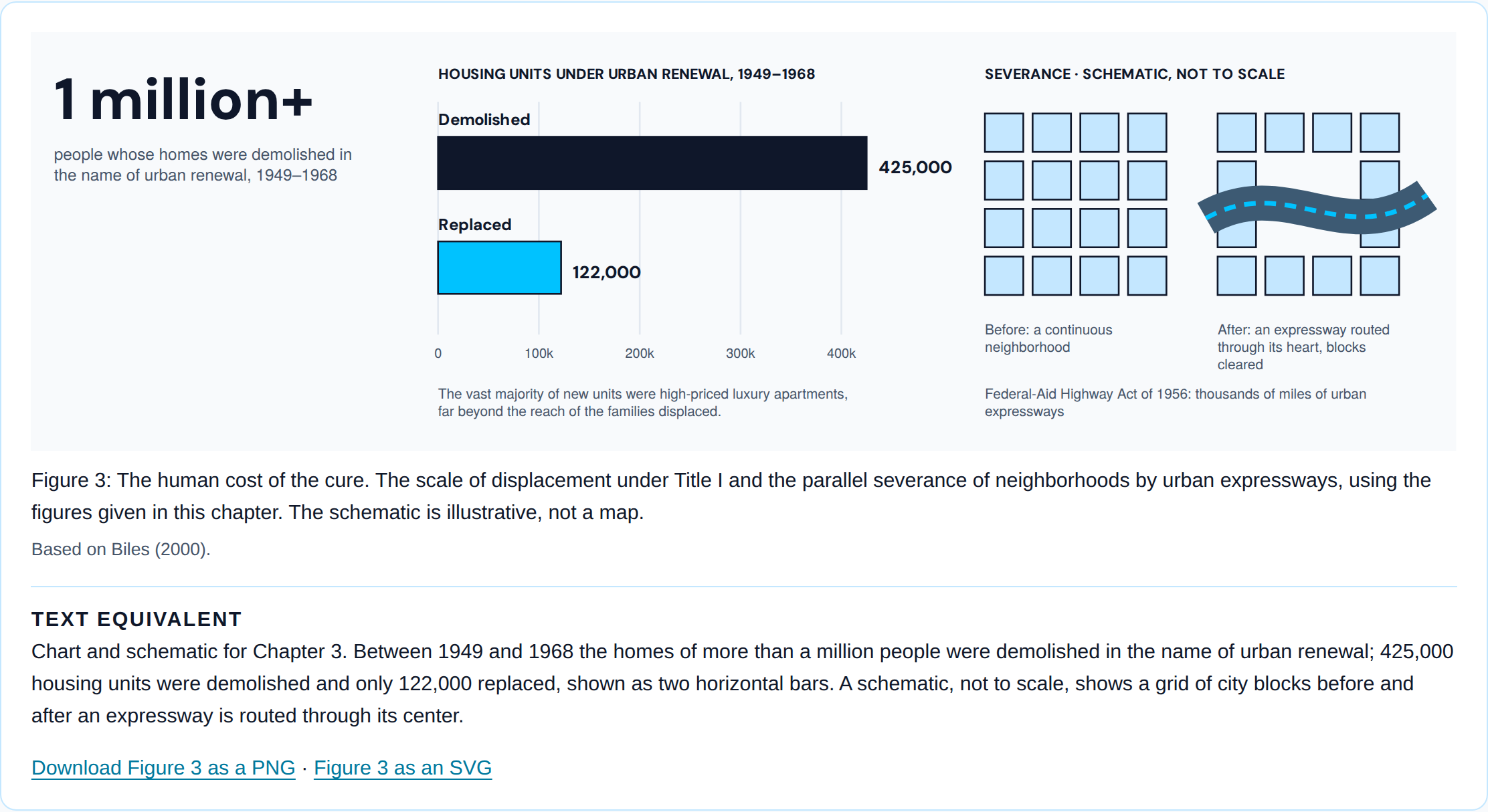
Based on Biles (2000).
Text equivalent
Chart and schematic for Chapter 3. Between 1949 and 1968 the homes of more than a million people were demolished in the name of urban renewal; 425,000 housing units were demolished and only 122,000 replaced, shown as two horizontal bars. A schematic, not to scale, shows a grid of city blocks before and after an expressway is routed through its center.

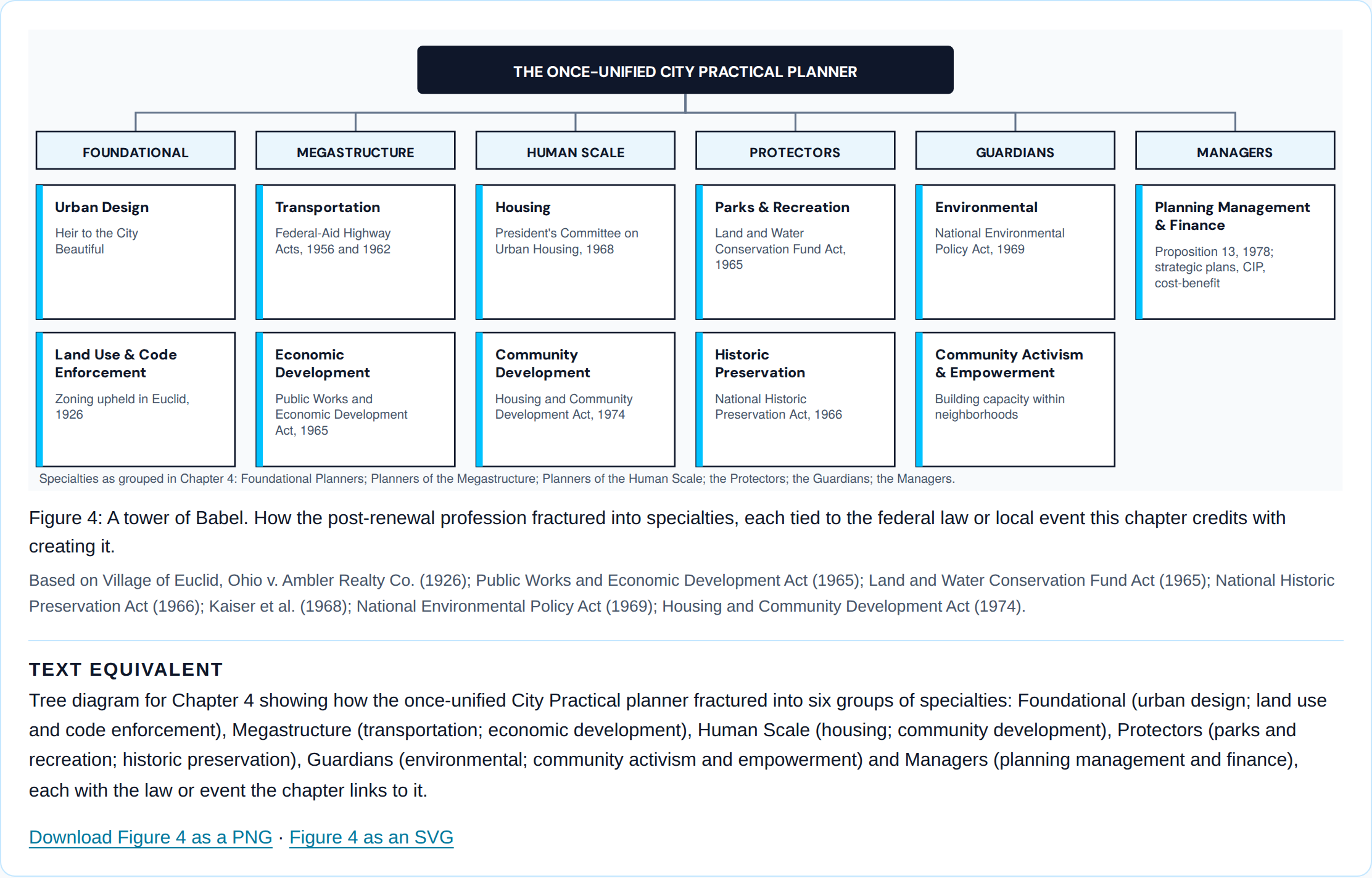
Based on Village of Euclid, Ohio v. Ambler Realty Co. (1926); Public Works and Economic Development Act (1965); Land and Water Conservation Fund Act (1965); National Historic Preservation Act (1966); Kaiser et al. (1968); National Environmental Policy Act (1969); Housing and Community Development Act (1974).
Text equivalent
Tree diagram for Chapter 4 showing how the once-unified City Practical planner fractured into six groups of specialties: Foundational (urban design; land use and code enforcement), Megastructure (transportation; economic development), Human Scale (housing; community development), Protectors (parks and recreation; historic preservation), Guardians (environmental; community activism and empowerment) and Managers (planning management and finance), each with the law or event the chapter links to it.

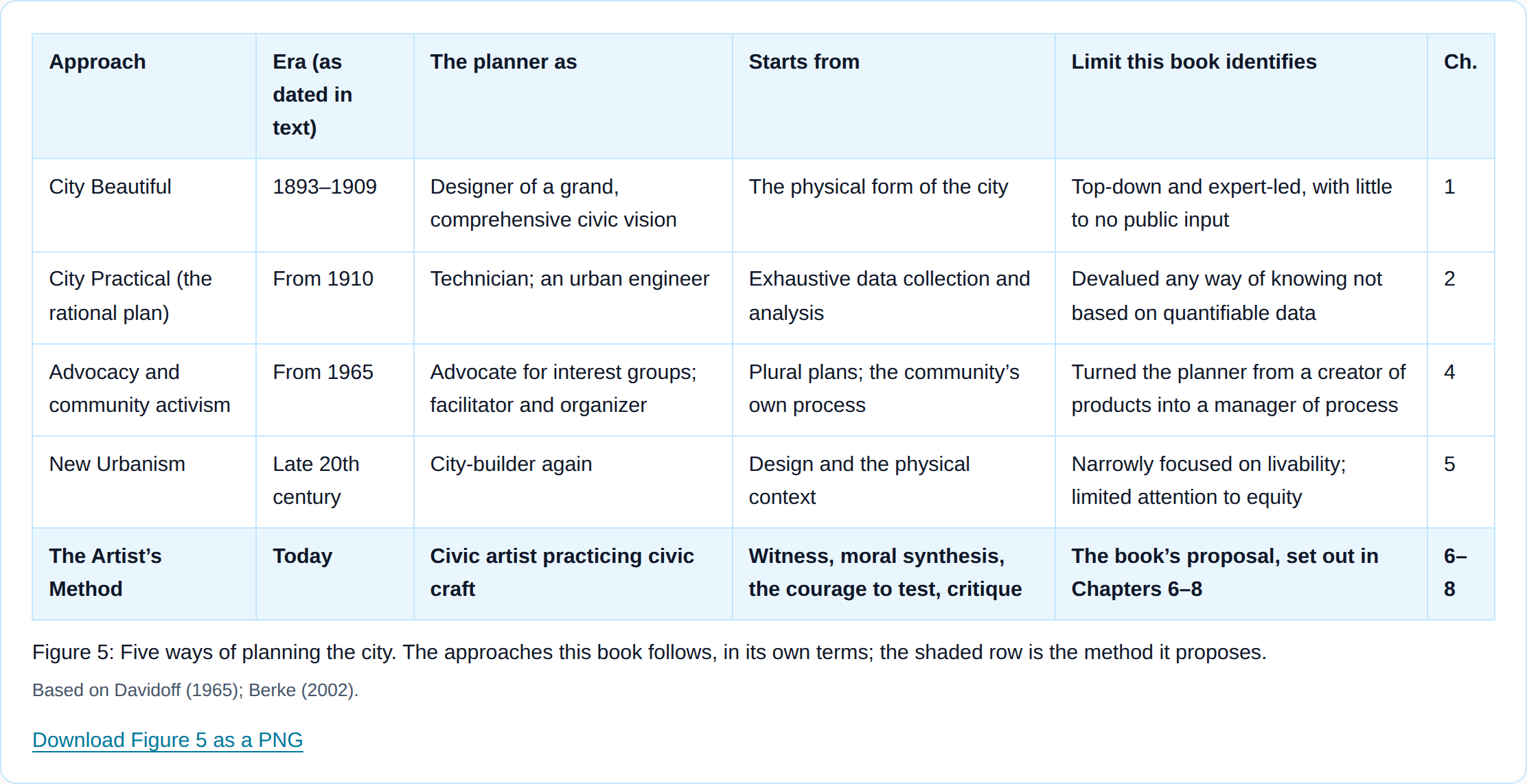
| Approach | Era (as dated in text) | The planner as | Starts from | Limit this book identifies | Ch. |
|---|---|---|---|---|---|
| City Beautiful | 1893–1909 | Designer of a grand, comprehensive civic vision | The physical form of the city | Top-down and expert-led, with little to no public input | 1 |
| City Practical (the rational plan) | From 1910 | Technician; an urban engineer | Exhaustive data collection and analysis | Devalued any way of knowing not based on quantifiable data | 2 |
| Advocacy and community activism | From 1965 | Advocate for interest groups; facilitator and organizer | Plural plans; the community’s own process | Turned the planner from a creator of products into a manager of process | 4 |
| New Urbanism | Late 20th century | City-builder again | Design and the physical context | Narrowly focused on livability; limited attention to equity | 5 |
| The Artist’s Method | Today | Civic artist practicing civic craft | Witness, moral synthesis, the courage to test, critique | The book’s proposal, set out in Chapters 6–8 | 6–8 |
Based on Davidoff (1965); Berke (2002).
Text equivalent
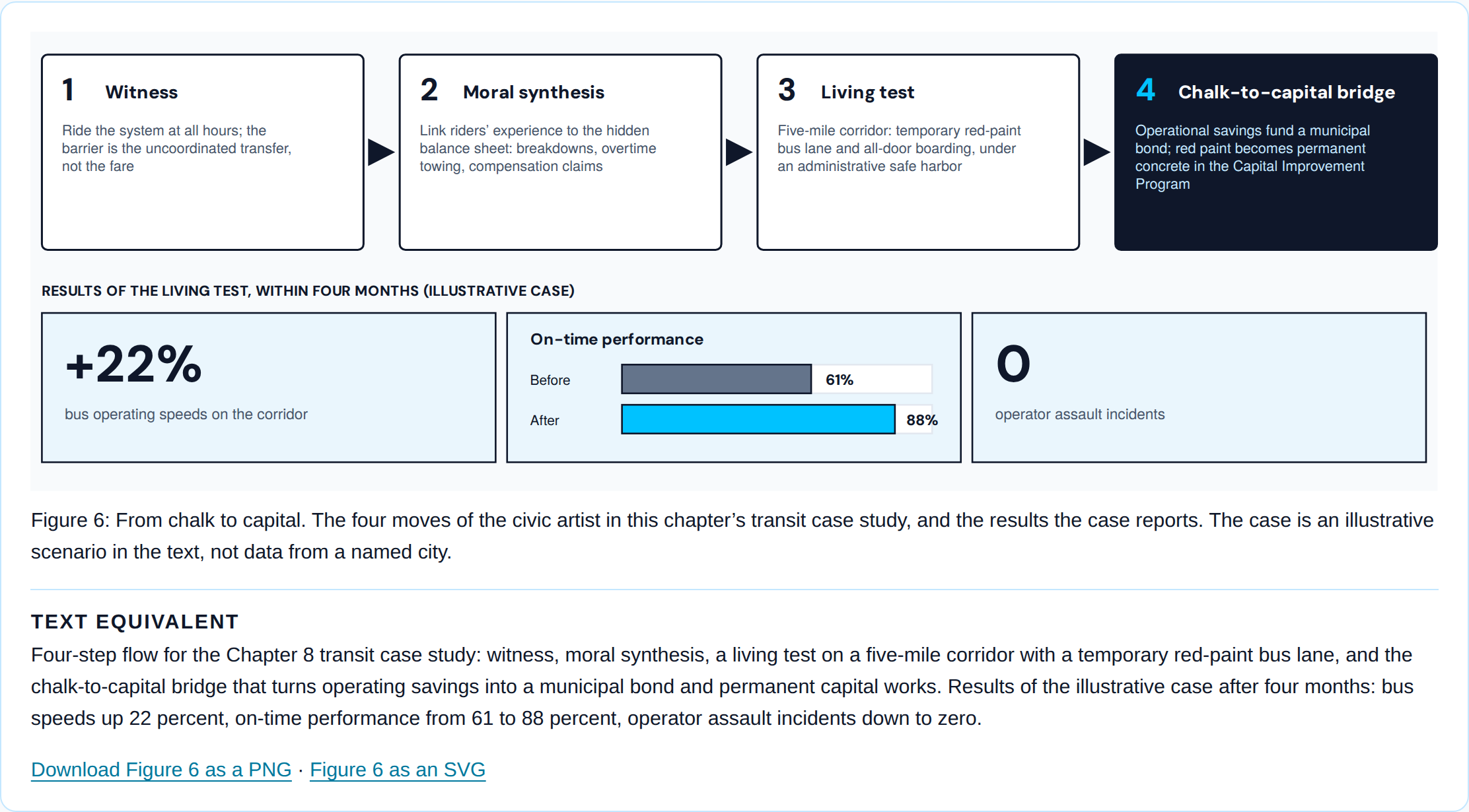
Four-step flow for the Chapter 8 transit case study: witness, moral synthesis, a living test on a five-mile corridor with a temporary red-paint bus lane, and the chalk-to-capital bridge that turns operating savings into a municipal bond and permanent capital works. Results of the illustrative case after four months: bus speeds up 22 percent, on-time performance from 61 to 88 percent, operator assault incidents down to zero.

More resources
The tools these figures serve: Tools. The whole book, free: The Book page. The remedy in brief: How to fix planning. The story behind it: How we got here.