How we got here
How we got here
How American planning lost its art, told in seven beats from the book, and how the Institute came to this project.
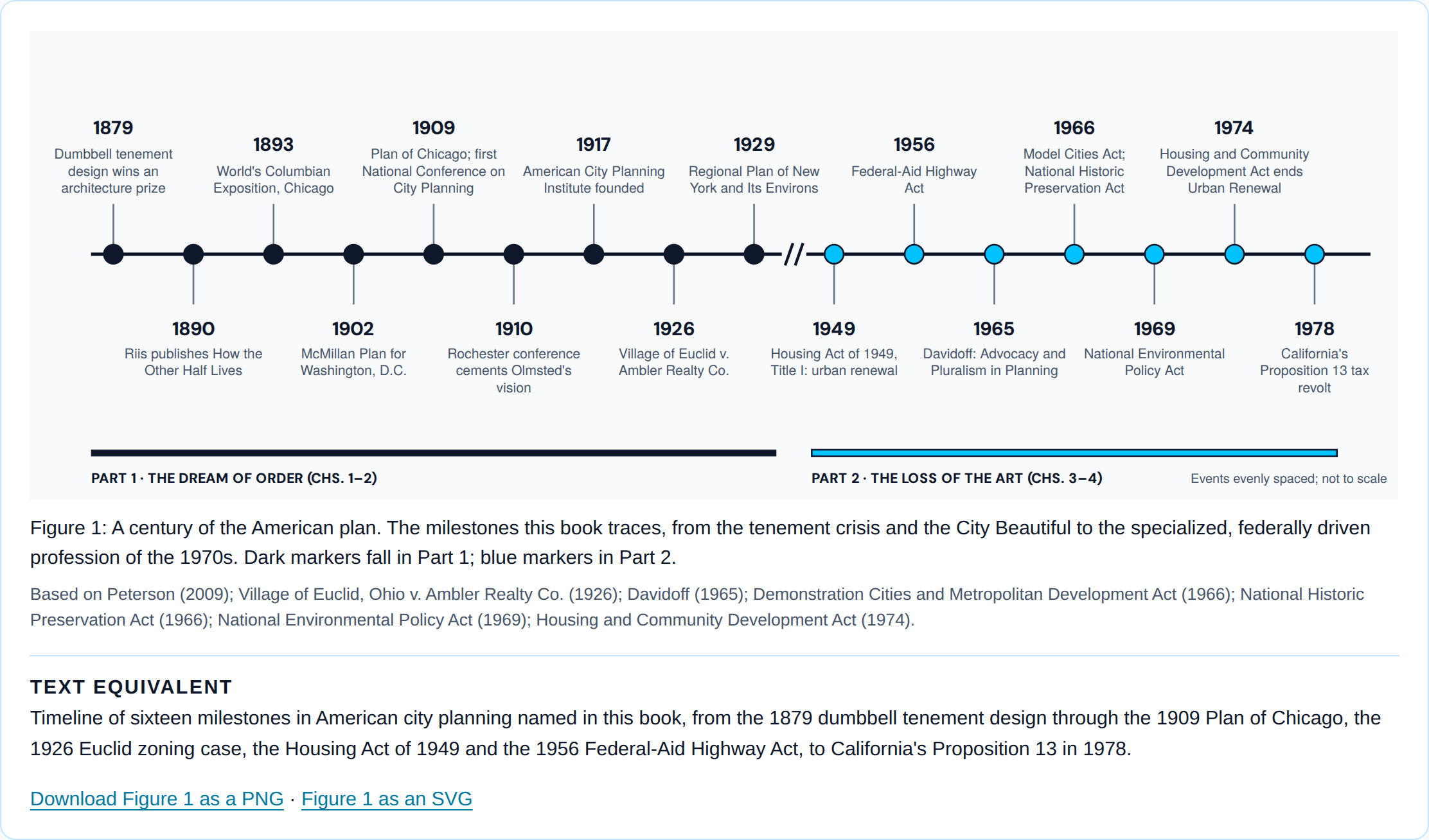
Based on Peterson (2009); Village of Euclid, Ohio v. Ambler Realty Co. (1926); Davidoff (1965); Demonstration Cities and Metropolitan Development Act (1966); National Historic Preservation Act (1966); National Environmental Policy Act (1969); Housing and Community Development Act (1974).
Text equivalent
Timeline of sixteen milestones in American city planning named in this book, from the 1879 dumbbell tenement design through the 1909 Plan of Chicago, the 1926 Euclid zoning case, the Housing Act of 1949 and the 1956 Federal-Aid Highway Act, to California's Proposition 13 in 1978.

Beat 1 · Chapter 1
Smoke and steam
To understand the scale of their ambition, one must first attempt to inhabit the sensory reality of that world. The tenement building was the physical epicenter of this crisis. The infamous “dumbbell” tenement design, a so-called reform that won an architecture prize in 1879, perfectly illustrates the perverse logic of the time. In reality, it was a dark, fetid chute that became a repository for garbage, waste, and stagnant air, effectively funneling noise and smells from one apartment to another. His 1890 book, How the Other Half Lives, was a landmark work of social documentary. It made it impossible for the city’s powerful classes to ignore the human cost of their progress.

Beat 2 · Chapter 1
The dream of order
That catalyst arrived in 1893, on the swampy shores of Lake Michigan, in the form of the World’s Columbian Exposition. At the heart of the fair was the legendary “White City,” a stunning, temporary metropolis designed by the nation’s preeminent architects and landscape architects, under the masterful direction of the architect and master organizer Daniel Burnham and the brilliant landscape architect Frederick Law Olmsted Jr. The White City became the foundational myth of the City Beautiful movement. If the McMillan Plan was the movement’s most elegant expression, the 1909 Plan of Chicago was its most audacious. The Plan of Chicago was the ultimate expression of the City Beautiful’s top-down, expert-led philosophy.

Beat 3 · Chapter 2
The city practical
The new philosophy was, at its core, a gospel of efficiency. The planner, in this new model, was not a social crusader or a civic artist; they were a technician, an urban engineer whose primary mission was to make the complex machinery of the city run more smoothly. The messy, unpredictable, and often irrational human condition, which had been the central focus of the reformers, was now seen not as the subject of the planner’s work, but as a problem to be managed, a variable to be controlled. The goal was no longer to heal the city’s social wounds, but to optimize its performance.
Beat 4 · Chapter 3
The cure that hurt
The program, in effect, became a massive, federally funded shell game, clearing out the poor to make way for the affluent. The planning profession, forged in the fires of the industrial revolution and legitimized by the cool logic of the “City Practical,” entered the 1940s with a clear and confident sense of purpose. The great debate between the visionaries and the reformers had been settled. A consensus had emerged: the planner was a technical expert, a rational professional whose mission was to bring comprehensive order to the physical environment.
Beat 5 · Chapter 4
A profession adrift
The intellectual and institutional crisis that followed Urban Renewal did not obliterate the planning profession entirely; instead, it fractured it. But the experiment had failed. Spectacularly. The results were in, and they were a damning indictment of the profession’s core beliefs. Instead of improving the human condition through the orderly removal of blighted conditions, the human condition for many, especially the poor and marginalized in the nation’s cities, was demonstrably worse. The consensus that had once unified the profession was shattered.
Beat 6 · Chapter 5
The search for a North Star
The planning profession does not have a mission problem. It has a method problem. The problem is not that the profession has forgotten what it is supposed to do. The problem is that it has forgotten how to do it. The story of the 20th century, for the planning profession, is the story of the slow, tragic, and almost accidental loss of its own original, intuitive, and artistic method. They were comprehensive, systemic thinkers who understood that the city was a complex, interconnected organism.

Beat 7 · Preface
How ICS came to this
The Institute for Civic Service (ICS) was founded on a conviction as old as the Republic itself: that public service is not mere bureaucratic maintenance, but a demanding, creative craft. The crises fracturing our shared civic life (the working families displaced by speculative housing, the transit riders stranded in daily exhaustion, the loneliness that shadows our public parks) are not tame mechanical puzzles waiting for another regulatory checklist. They are wicked systems, where an isolated decision in one department ripples through the lives and dignity of entire neighborhoods.
The Lost Art of the Plan is both an indictment of our administrative retreat and an invitation to renewal.
Content needed
How ICS came to this project
Beyond the Preface’s founding conviction, quoted above, the story of how the Institute came to this book is the Chair’s to tell. It will be added here in his words.