
How to fix planning
How to fix planning
“The problem is not that the profession has forgotten what it is supposed to do. The problem is that it has forgotten how to do it.” Chapter 5, “The Real Search”
The method in four moves
The book’s answer is a method, not a mission statement: the Artist’s Method, stated in the Preface and practiced in Chapter 6.
Witness
“the discipline of witness, which leaves behind the aerial abstraction of the spreadsheet to listen with reverence to the lived reality of the street”
Preface, The Lost Art of the Plan
Moral synthesis
“the art of moral synthesis, which sees across bureaucratic silos to weave housing, transit, and public health into a singular civic tapestry”
Preface, The Lost Art of the Plan
The courage to test
“the courage to test, which de-risks the civic imagination by trying small, humble experiments on the pavement before pouring irreversible concrete”
Preface, The Lost Art of the Plan
Critique
“the discipline of critique, which confronts broken historical promises and ends the amnesiac cycle of municipal erasure”
Preface, The Lost Art of the Plan
“To lead our cities out of this long twilight, we do not require another imported management trend from corporate consulting, another proprietary software dashboard that promises to automate spatial decision-making, or an even more convoluted series of procedural checkpoints. We must perform a far more radical and courageous act: we must reclaim the forgotten soul of the discipline. We must recover the lost art of the plan.”
Chapter 6, “The Planner and the Calling of Civic Craft”
Make room to test
The Administrative Safe Harbor
Yet to demand that municipal civil servants exhibit the courage to experiment without providing them institutional protection is an exercise in administrative cruelty.
“If local government is to recover the lost art of the plan, it must construct what we term the Administrative Safe Harbor.”
Chapter 8, “The Administrative Safe Harbor”
An administrative safe harbor is a formal municipal policy, enacted by the city council or executive order of the city manager, that establishes an explicit zone of procedural protection for authorized civic experimentation.
Test before concrete
The Living Test, then the bridge
The practice of civic craft shatters this paralysis through the living test. A prototype in the public realm is not an artistic indulgence or a frivolous community festival. It is an act of disciplined civic empirical inquiry. This is the great virtue of the prototype: it surfaces truth cheaply.
“The practitioner of civic craft understands that a prototype is not a destination; it is the opening argument for a capital reallocation.”
Chapter 8, “The Chalk-to-Capital Bridge”
Text equivalent
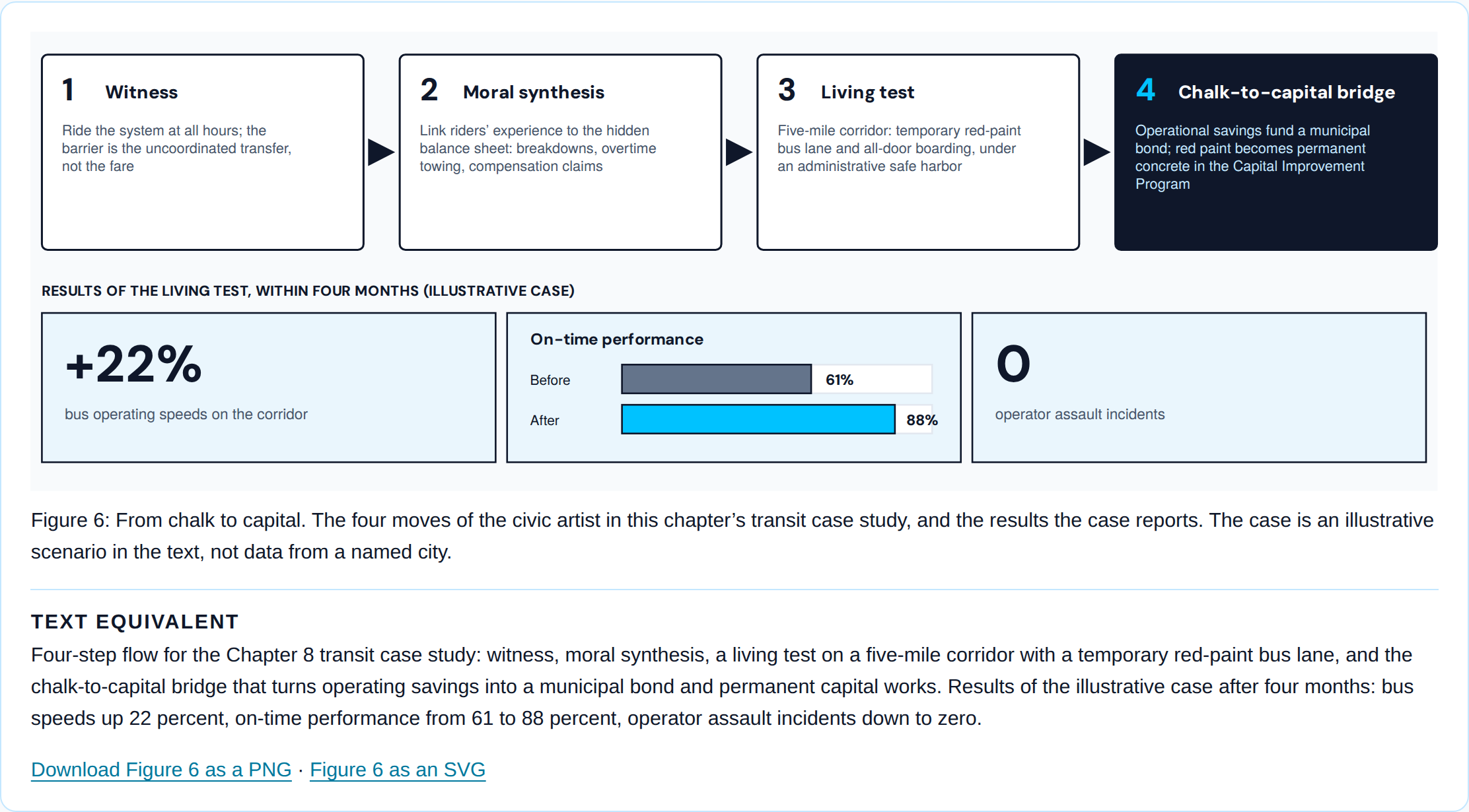
Four-step flow for the Chapter 8 transit case study: witness, moral synthesis, a living test on a five-mile corridor with a temporary red-paint bus lane, and the chalk-to-capital bridge that turns operating savings into a municipal bond and permanent capital works. Results of the illustrative case after four months: bus speeds up 22 percent, on-time performance from 61 to 88 percent, operator assault incidents down to zero.

Work with the system
Chapter 7 teaches the practitioner to see the system as it is: wicked, contested, and self-reinforcing, and to plan with it rather than around it.
Wicked systems, not tame problems
“In the lexicon of systems theory, a tame problem possesses clear boundaries, an unambiguous cause, and an identifiable, definitive technical cure.”
Veto points
“It is here that the modern planner must abandon all naive sentimentality.”
The urban thermostat
“Once power is understood and navigated, the operational mandate of the planner shifts fundamentally: we must stop acting as passive recorders of urban decay and become active designers of urban equilibrium.”
A worked example
Rebuilding the Circulatory System
Illustrative composite
To witness the full synthesis of civic craft in operation, consider a major metropolis confronting the steady, agonizing decline of its public transit network. In the typical municipal paradigm, transit collapse is treated as a mechanical financial deficit.
Within four months, the empirical results of this living test reverberate through the system. Bus operating speeds on the corridor increase by twenty-two percent, allowing the agency to run more frequent service with fewer vehicles. On-time performance jumps from sixty-one percent to eighty-eight percent, and operator assault incidents drop to zero as boarding friction evaporates.
The case study in this chapter is an illustrative composite and names no city. (The book’s own note, at Plate 8.1.)
Train the next planners
Reclaiming the Civic Academy
If the Artist’s Method is to become an enduring reality rather than an ephemeral theory, it cannot remain confined to the heroic efforts of a few isolated practitioners or visionary city managers. It must be institutionalized.
“We must restore the civic studio to the absolute center of the planning curriculum.”
Chapter 6, “Reclaiming the Civic Academy”
“The tools are assembled. The method is proven. It is time to cast aside the gray mantle of the clerk, step into the light of the street, and take up once more the magnificent, unfinished work of seeing the city whole.”
Chapter 8, “The Final Narrative: A Call to the Republic”